The Truth Behind Bangalore’s Traffic: Conversation with Ms Manjula Vinjamuri.
About this episode
A conversation with Manjula Vinjamuri, Former Commissioner of DULT — India’s only dedicated urban transport directorate on why Bangalore did almost everything right and still became one of the most congested cities in the world.
Bangalore tried.
That is what makes this conversation so difficult. This is not a story about a city that ignored the problem. Bangalore created India’s only dedicated urban transport directorate. It wrote comprehensive mobility plans. It built cycling infrastructure. It launched bus rapid transit pilots. It ran 500 cycle days before the pandemic came in. It passed the BMLTA Act through the legislature. It won national awards for urban mobility innovation.
And yet in 2026, Bangalore is ranked among the most congested cities in the world. Cycling which once accounted for 18 percent of all trips, collapsed to just 2 percent. The bus network lost nearly a third of its daily passengers. The city adds over 2,100 new vehicles to its roads every single day.
The question this conversation keeps circling is not whether Bangalore failed. It is something harder: what does it mean when a city does almost everything right and still ends up here?
WHO IS MANJULA VINJAMURI
Manjula Vinjamuri served as the Commissioner of DULT — the Directorate of Urban Land Transport, Karnataka’s state-level urban transport planning body and the only institution of its kind in India. She joined in 2010 and spent years building DULT from a nascent organization with four transport planners into a body that shaped policy, trained practitioners and influenced urban mobility thinking at the national level.
She oversaw the drafting of the BMLTA Act — Bangalore’s unified metropolitan transport authority and pushed the active mobility bill through multiple rounds of public consultation. She worked on bus priority lanes, parking policy, cycling infrastructure, pedestrianization projects and transit-oriented development frameworks.
She is now retired. And in this conversation she is more honest about what went wrong than most people who were inside the system are willing to be.
THE CONVERSATION
I want to be honest about what I expected from this conversation. I thought it would be defensive, an insider protecting the record of an institution she helped build.
What I got instead was something much more valuable. Manjula Vinjamuri is clear-eyed about the gap between what was planned and what was built. About who made decisions and why. About what the plans actually said versus what the plans actually did. And about what she believes still needs to change — even after twenty years of trying.
1. On why Bangalore grew faster than anyone planned for
I asked Manjula to start at the beginning. Why does Bangalore still feel broken after twenty years of serious, sustained effort?
Her answer was not political. It was structural. Nobody anticipated that Bangalore would grow at the pace it did. The IT boom of the 1990s transformed the city faster than any planning framework could absorb. And the infrastructure — the roads, the metro, the buses could not keep pace with growth that was, in her words, exponential.
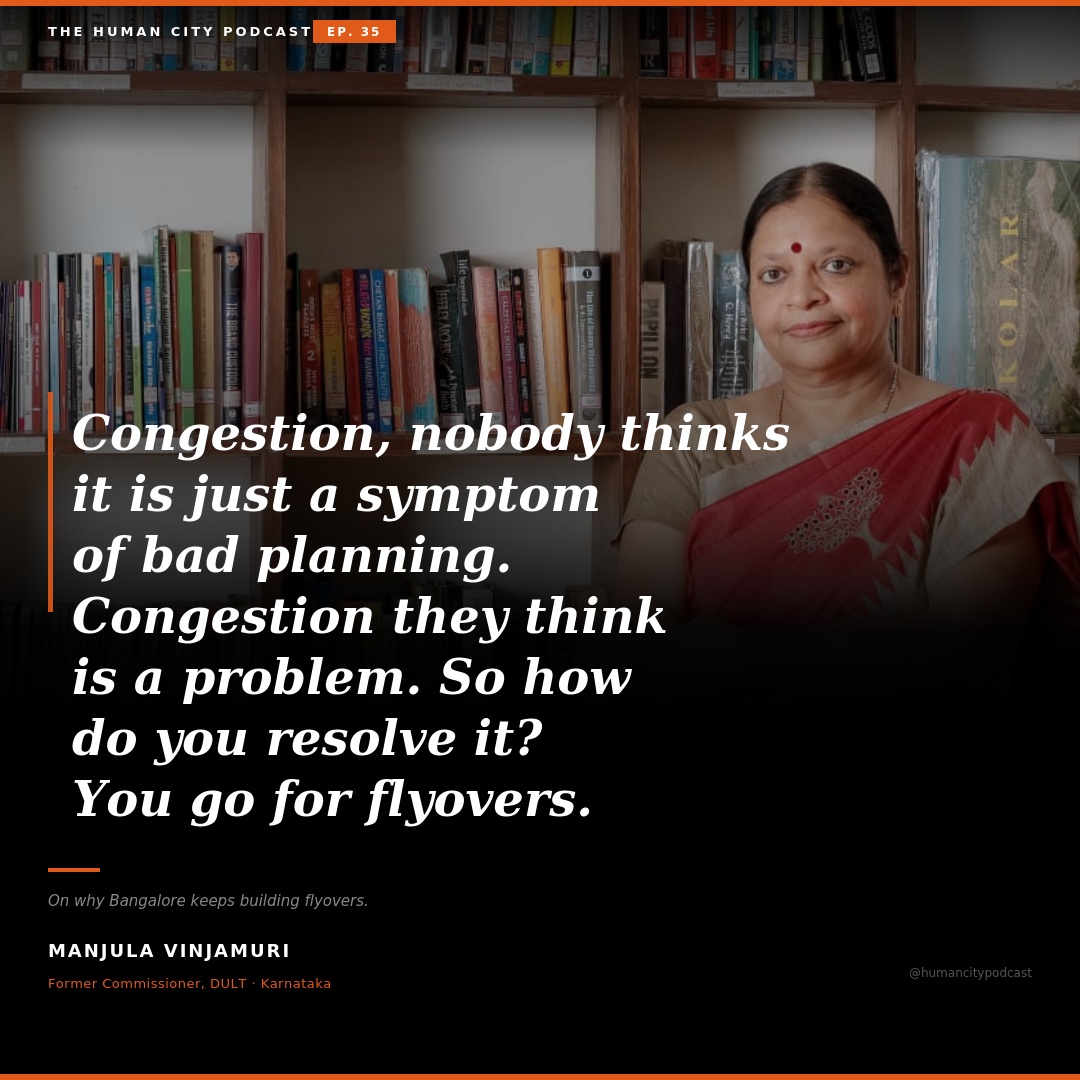
But then she said:

That sentence contains twenty years of urban transport policy in India compressed into three lines. The moment you treat congestion as the problem instead of the symptom, you build flyovers. And flyovers do not solve congestion. They defer it. And by the time the next flyover is being planned, the city has already filled the space the previous one cleared.
2. On what DULT actually was — and what it was not
DULT was set up in 2007, right after the National Urban Transport Policy came into force. The idea was innovative — a dedicated planning body for urban transport, separate from the traffic police and the bus corporations and the metro authority, with the mandate to think about how the whole city moves. The reality was more modest.

Think about what that means. India’s only dedicated urban transport directorate — the institution that was supposed to coordinate mobility planning for a city of twelve million people — started with four planners. The support staff outnumbered the people doing the actual work.
And there was a deeper problem. Urban transport planning in India had no institutional home. It was split between the traffic police, who managed movement; BMTC, which ran the buses; BMRCL, which built the metro; and BBMP, which owned the streets. None of them reported to the same department. DULT was supposed to be the connective tissue. But connective tissue without authority is just paper.
3. On the comprehensive mobility plan that became a funding document
One of the most important questions I asked in this conversation was about Bangalore’s comprehensive mobility plan — the document that was supposed to set the vision for how twelve million people would move through the city.
There has long been a criticism that the CMP became more of a document to unlock metro funding than a true mobility roadmap. I asked Manjula if that was fair.
She said yes.

This is the central failure she keeps returning to. A plan without legal force is just a wish list. Implementing agencies were inspired by the CMP but not bound by it. And what was convenient, almost always, was the big infrastructure — the metro expansion, the road widening, the things with visible milestones and political value.
The low-hanging fruit - the footpath improvements, the parking policy, the cycling network — never got the same attention. Not because they were harder. But because they were smaller. They did not generate the kind of political visibility that a metro station inauguration does.
4. On buses — the poorer cousin to mass transit
Buses are the lifeline of any Indian city. They carry more people than the metro. They reach more areas than any rail system will for decades. And they have been consistently treated as the less important problem.

The problem is structural. Bus fares cannot be raised because the public will resist and the government will not accept the political cost. But fuel costs go up. Manpower costs go up. The result is bus corporations that are structurally loss-making, chronically underfunded and unable to invest in fleet or service quality.
And then there is the coordination problem. BMTC reported to the Transport Department. BMRCL reported to Urban Development. They were not required to talk to each other. Route planning, metro feeder services, bus priority lanes, all needed coordination between agencies that had no formal mechanism for it.
5. On what actually kills good urban design
The most revealing part of this conversation came when I asked Manjula about the reform she believed in most strongly that never happened on the ground.
She talked about the active mobility bill - legislation that would have given legal teeth to footpath design standards, cycling infrastructure requirements and pedestrian rights of way. She spent years building it. She got over 500 public responses. She took it to the government. It is still a bill.

This is the story of urban design in India in one sentence. The plan is good. The design is good. And then someone needs a parking space. And the negotiation begins. And by the time it is over, the footpath is one metre wide instead of three.
6. On electric vehicles and the traffic jam that does not care about the engine

Electric vehicles may reduce tailpipe emissions. They do nothing for congestion. They do nothing for road space. If the cost of electric cars comes down and more people switch, Bangalore’s roads get more cars — cleaner cars, but more cars. The problem gets worse, not better.
What Bangalore needs is not electric personal vehicles. It is electric buses. More of them, cheaper to operate, running more frequently on routes that actually serve where people live and work.
WHY THIS MATTERS FOR EVERY INDIAN CITY
Bangalore is not unique. It is the most visible example of a problem that exists in every Indian city that has grown faster than its planning. The congestion. The fragmented agencies. The plans with no legal force. The footpaths negotiated down to one metre. The buses chronically underfunded because fares cannot be raised.
What Manjula Vinjamuri built at DULT matters not because DULT solved the problem — it did not — but because it demonstrated that the problem can be named, institutionalized and worked on systematically. That transport planners can exist inside government. That a unified authority can be passed into law. That 500 cycle days can happen.
The tipping point requires simple initiatives done fast that yield consistent results over the long term. Not flyovers. Not tunnel roads. Not electric cars.
LISTEN TO THE FULL EPISODE
Search ‘The Human City Podcast’ on Spotify, Apple Podcasts, or YouTube.
Episode 35 — The Truth Behind Bangalore’s Traffic. A conversation with Manjula Vinjamuri, Former Commissioner, DULT.
[ Watch on YouTube ] [ Listen on Spotify ] [ Listen on Apple Podcasts ]
ABOUT THE HUMAN CITY PODCAST
The Human City Podcast is hosted by Ruchita Bansal , urban planner, founder of SheCity India, and practitioner with over 15 years of experience inside large Indian urban projects. Each episode is a long-form conversation with thinkers, practitioners, and city-makers asking the harder questions about how cities work and who they actually work for.