We Are Destroying Cities: Why Indian Cities Feel Broken with Dr. Sanjeev Kumar Lohia
About this episode
A conversation with Dr. Sanjeev Kumar Lohia, Former Joint Secretary, Ministry of Urban Development, Government of India on 20 years of urban transport policy, the politics of implementation, and why Indian cities are still at 5 percent of where they need to be.
There is a moment in this conversation that I keep returning to.
I asked Dr. Sanjeev Kumar Lohia, the man who was in the room when India's National Urban Transport Policy was being written, who spent two decades nudging cities toward equitable streets, buses, cycling and pedestrian infrastructure whether we were realistically becoming less car dependent after 20 years of missions, reforms and thousands of crores of investment.
He paused. And then he said it. "We are at 5 percent. Not even 5 percent." "The way we are going focusing only on private transport, we are destroying cities."
This was not said in anger. It was said with the exhausted clarity of someone who has watched the same mistakes repeat for two decades and has run out of ways to soften the truth.
WHO IS DR. SANJEEV KUMAR LOHIA
Dr. Sanjeev Kumar Lohia served as Joint Secretary in the Ministry of Urban Development, Government of India. He was a central figure in the design and implementation of the Jawaharlal Nehru National Urban Renewal Mission (JNNURM) which was India's most ambitious urban transformation programme when it launched in 2005.
He was involved in framing the National Urban Transport Policy, the Urban Bus Specifications that transformed the quality of city buses across India, the National Common Mobility Card, and the form-based codes for railway station redevelopment. He watched BRT systems rise and fall. He sat across the table from politicians, bureaucrats, state governments and metro corporations. He has seen this from the inside for longer than most people have been thinking about it.
He is now one of the most honest voices on what actually happened and what did not.
THE CONVERSATION
I want to be honest about what I expected from this conversation. I thought it would be diplomatic, careful bureaucratic language, credit given where credit is due, criticism softened by institutional loyalty.
What I got instead was one of the most candid conversations I have had about how policy actually works in India. How money moves. How politicians think. How consultants are told what conclusions to reach before the study begins. And why, despite everything, the cities are still losing.
1. On the root of the problem
I asked Dr. Lohia what problem Indian cities were actually trying to solve in 2005 when the National Urban Transport Policy was introduced. His answer was not what I expected.
He did not talk about congestion or infrastructure gaps. He went deeper. To the constitution itself.

Think about what that means. Every decision about how a city moves- who gets road space, whether buses are funded, whether pedestrians are considered is split between central government ministries, state governments and urban local bodies. Nobody owns it. Nobody is fully responsible. And without ownership, there is no accountability.
This is not a failure of one government or one policy. It is structural. It was built into the system from the beginning.
2. On who actually makes the decisions
I pushed him on implementation. The National Urban Transport Policy talked about equitable streets, modal equity, pedestrians and cyclists alongside cars. But what actually got built between 2006 and 2012 was flyovers and metro lines. Why? He did not deflect. He said it plainly.

There is an old Hindi saying he quoted - wo kya jaane peer parai, jake paavna fati biwai. Roughly: “how can you understand someone else's pain if you have never walked in broken shoes”. The people making decisions about streets in Indian cities have never waited for a bus in the heat. They have never navigated a broken footpath carrying groceries. Their city is experienced through tinted glass. So that is the city they keep building.
3. On projects versus systems
One of the most damning observations in this entire conversation came when I asked whether cities were building projects instead of creating systems.
He did not hesitate.
"Yes. Always." And then he said something that should be carved into the wall of every urban planning office in India.

This is not a minor procedural complaint. This is a confession that the studies used to justify urban transport projects were sometimes written backwards, starting from the conclusion and building the evidence to match. The comprehensive mobility plans that cities submitted were, in many cases, just compilations of projects they had already decided to build, given a new cover page.
The system was not broken. It was working exactly as designed to move money, not people.
4. On how to sell an idea to a politician
The most cinematic moment in this conversation was when I asked Dr. Lohia about the hardest thing to convince politicians about when it comes to urban transport.
He told me about a minister he spent months trying to persuade to fund city buses. The minister kept refusing - STUs are loss-making, the money will go down the drain. And then one day, mid-conversation, something shifted.

He was not selling buses. He was selling visibility. He was not making a technical argument. He was making a political one. And the moment he understood that distinction, the moment he stopped talking about modal equity and started talking about eyeballs and the project happened.
This is both a lesson and an indictment. The most important urban transport investments in India's history got funded not because the case was compelling on its merits but because someone figured out how to make a politician see themselves in the project.
5. On how much of urban transport is actually technical
I asked him directly. How much of urban transport is technical and how much is political? He did not pause.

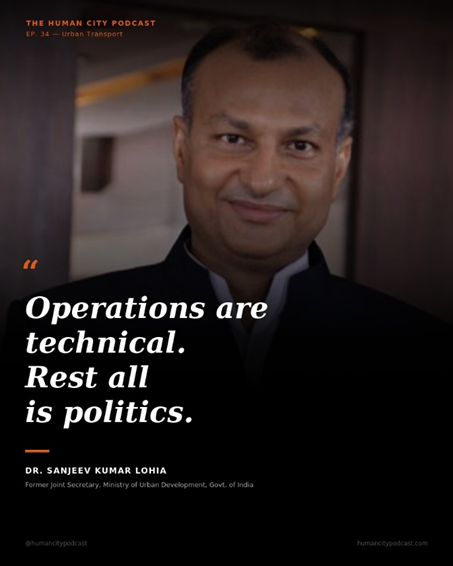
Five words. Twenty years of experience compressed into five words. The engineering of running a bus on time, maintaining a metro, calibrating a signal, that is technical. Everything else - which route gets funded, which city gets the metro, whether buses or flyovers, who gets to sit at the table, is political. And politics, in India's urban transport context, has almost always favoured the car.
6. On density, TOD and the Dharavi question
We spent time on transit-oriented development - the idea that you build density around transit corridors so that people can live, work and move without a car. It has been discussed in India for twenty years. It has barely been implemented anywhere.
I asked whether Indian cities misunderstand density.

It is a question that reframes the entire TOD conversation. India already has density. What it does not have is planned density, density that is designed around movement, around mixed use, around the idea that you should be able to walk to work. When cities hear TOD, they hear higher FSI. They increase the floor space index along a corridor and call it done. The placemaking, the mixed use, the pedestrian infrastructure, the last-mile connection that is all missing.
TOD without public transport is just real estate. And most of what India has built under the TOD label is exactly that.
7. On PPP and the 88 percent failure
Public-private partnership was supposed to be the answer. Private sector efficiency. Government oversight. The best of both worlds. The reality has been somewhat different.
Dr. Lohia did a survey of metro projects run on PPP globally. Eighty-eight percent failed.
Hyderabad Metro — L&T has exited. Airport line in Delhi, the fate is known. Private metro in Gurugram, also known. Manila Metro globally. The pattern is consistent. Metro infrastructure requires massive upfront capital, years before ridership consolidates, and complete dependence on surrounding urban development and feeder services that the private party cannot control. No private investor can price that risk. So, they either don't come, or they come and eventually leave.

The government thinks it has transferred the risk. But public infrastructure cannot be sold in the market when a project fails. The risk always comes back to the public. The only question is how much has been lost in the meantime.
8. On where we are after 20 years
I asked the question I had been building toward for the entire conversation. After JNNURM, Smart Cities Mission, AMRUT - after twenty years of missions and reforms and thousands of crores, are Indian cities realistically becoming less car dependent?
In 2005, he reminded me, the concept of urban transport in India was simple: make more roads, build more flyovers. There was no talk of pedestrians. Buses were for poor people. The idea that the central government had any role in how cities moved was itself a new concept.
Twenty years later, some things have changed. Cities have dedicated transport corporations. Some buses have AC. BRT works in Ahmedabad. The National Common Mobility Card exists. Metro networks have expanded. Things have happened.
But.

Urban centres contribute 60 to 70 percent of India's GDP. If they get choked and they are getting choked, that growth gets affected. People have already started relocating from Bangalore. The city that was supposed to be India's Silicon Valley is now a cautionary tale about what happens when you build an economy on a city and forget to build the city.
WHY THIS MATTERS
India is at an inflection point that will not come again. The cities that are being built right now - the corridors being laid, the densities being planned, the transport investments being made will define how half a billion people move for the next fifty years. Retrofitting a car-dependent city is orders of magnitude harder and more expensive than building it right in the first place.
Dr. Lohia's argument is not anti-car. It is pro-choice. Give people options. Build systems, not projects. Fund buses alongside metros. Make TOD mean something beyond an FSI number. Create unified transport authorities that force departments to actually talk to each other. Make cleanliness-style rankings for public transport so cities feel competitive pressure to perform.
None of this is technically difficult. All of it is politically hard. Which is exactly what he said at the beginning. Operations are technical. Rest all is politics.
The question is whether the political will arrives before the mess becomes irreversible.
THREE THINGS I AM STILL THINKING ABOUT
01. The consultant who was told what to conclude. Before the study began. The report was written to justify a project that had already been decided. This is not an exception in Indian urban planning. It is, from what Dr. Lohia describes, closer to standard practice. And if the studies are written backwards, the decisions are made before the evidence arrives. We are not making planning decisions. We are making political decisions and dressing them in planning language.
02. The AC bus story. One of the hottest cities in India refused to provide AC buses for its citizens. Dr. Lohia told them — fine, then we will not provide AC in the Metro we are sanctioning for you. Twenty seconds of silence. The message was received. Think about what that story reveals about who we think deserves comfort in a city. The Metro passenger gets air conditioning as a matter of course. The bus passenger is told they do not want it. The only difference between these two people is which vehicle they can afford.
03. Gurugram and the transition from world class to third class. Dr. Lohia used this phrase — the transition from world class to third class is immediate. You step out of a gleaming tower and into a road with no footpath. You cross a highway with no pedestrian crossing. The island of excellence exists inside the compound wall. Outside it, the city is exactly as hostile as it was before the investment arrived. This is what happens when you build for residents and ignore the city. The gap is not accidental. It is the consequence of twenty years of building projects instead of systems.
LISTEN TO THE FULL EPISODE
Search 'The Human City Podcast' on Spotify, Apple Podcasts, or YouTube.
Episode 34 — Why Indian Cities Feel Broken? A conversation with Dr. Sanjeev Kumar Lohia.
[ Watch on YouTube ] [ Listen on Spotify ] [ Listen on Apple Podcasts ]