Why Footpaths Are Never Fixed in Our Cities ? HC E33| Nuria Forques | Ruchita Bansal
About this episode
A conversation with Nuria Forqués Puigcerver, urban designer, co-founder of Fitted Projects and creator of the Global Street Atlas on why the streets we build keep failing the people who walk them.
Nuria Forqués travels with a tape measure.
Not metaphorically. An actual tape measure, a laser measure and a notebook. She lands in a city, walks its streets, and measures them — sidewalk width, usable passage, tree placement, where the zebra crossing begins and ends and whether it is blocked by a pole someone forgot to move.
She started doing this because she needed references for her design work and discovered that no centralised resource for this information existed anywhere in the world. Four years later, she has a collection of photographs she privately calls "sidewalks to nowhere."
A perfectly designed footpath. Five metres wide on the plan. Suddenly ending at a highway with nowhere to go.
WHO IS NURIA FORQUÉS PUIGCERVER
Nuria Forqués Puigcerver is an urban designer and the Founder and Principal Urban Designer at Fitted Projects, a market-centric urban planning practice that works predominantly with the private sector across the Global South.
She is the creator of the Global Street Atlas - an open platform that documents street dimensions and design at a granular level across cities worldwide. The project was born from a simple problem: Nuria needed real-world street measurements as references for her design work and discovered that no centralised resource existed.
Her work spans greenfield urban development, street design, housing and public space with a particular focus on making projects financially sustainable and actually implementable, not just visually compelling.
THE CONVERSATION
I want to be honest about what I expected from this conversation. I thought it would be technical — cross-sections, design standards, case studies from Barcelona and New York. What I got instead was one of the most pragmatic and quietly radical conversations I've had about what it actually takes to build streets that work.
Nuria is not an idealist. She works mostly with private developers. She talks about budgets before she talks about beauty. And she questions everything — including herself.
1. On what most people misunderstand about streets
When I asked Nuria what most people get wrong about how streets work, she said something simple that I have been thinking about ever since.
There is a disconnect between the experience of walking a street every day and the decisions being made about that street. The person who designs it and the person who lives with it are almost never the same person. And nobody is checking whether the gap between them has been closed.
This is not an accident. It is a structural problem. The people making decisions about streets are working from guidelines, not from sidewalks. They are drawing lines on plans, not measuring what is actually there.
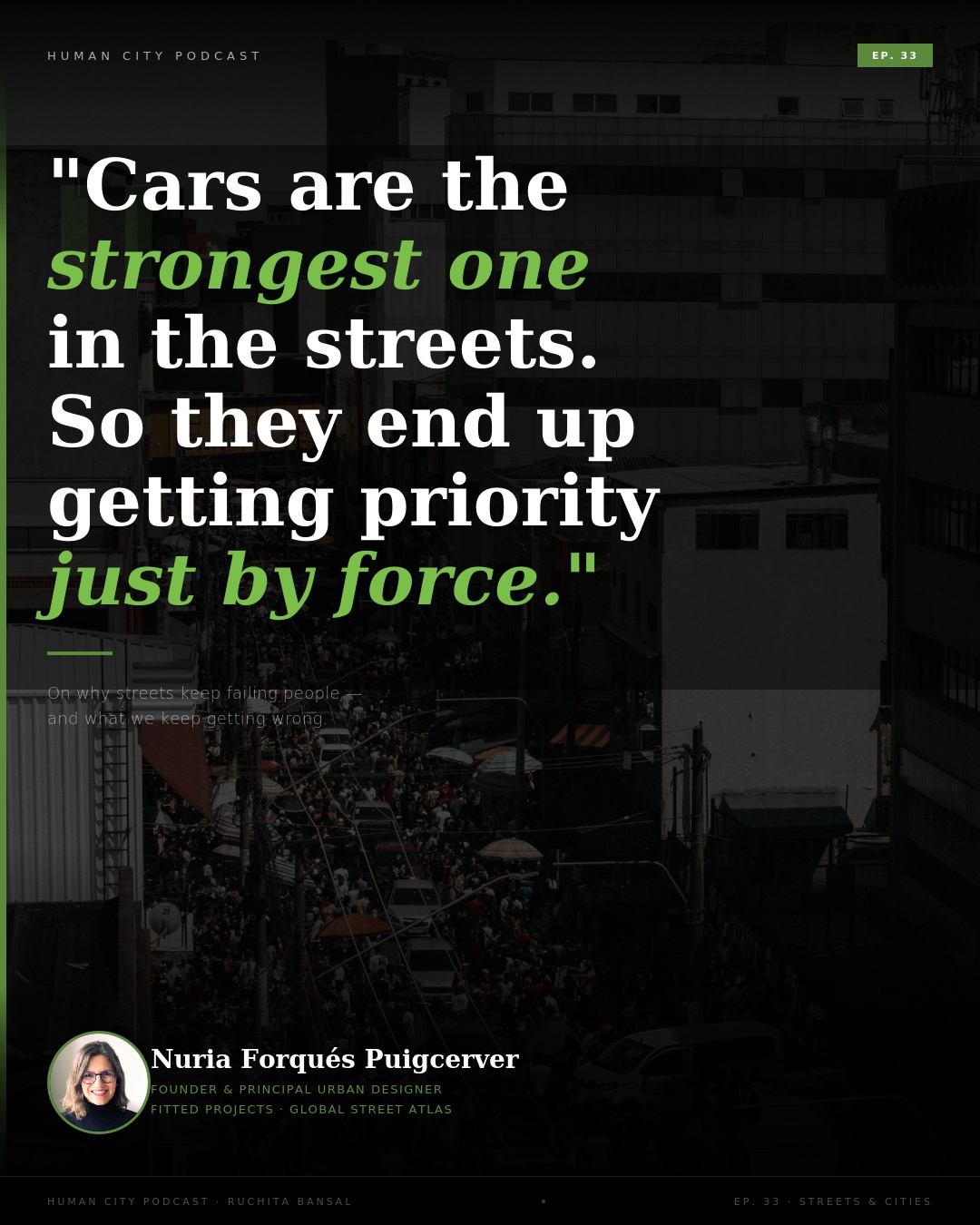
This is how it starts. Not with malice. Not even with a decision. Just with an absence of rules — and something heavy filling the vacuum.
2. On the Global Street Atlas
The Global Street Atlas was born from a gap that should not exist. Nuria was designing new greenfield developments and needed to understand the scale of what she was proposing. How wide is a good sidewalk? How do different cultures use the same dimensions differently?
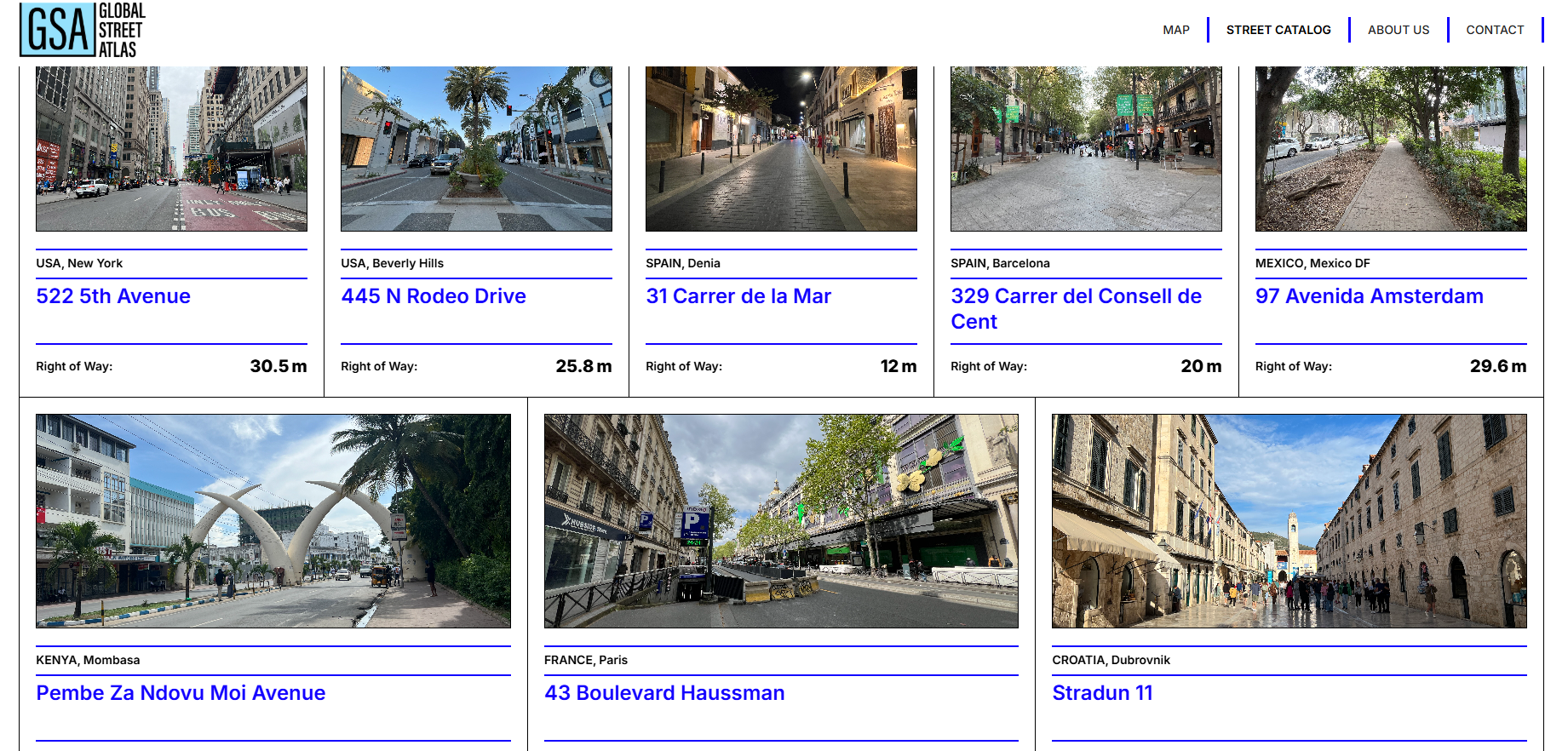
She went looking for a centralised resource. There wasn't one. So she started measuring herself.
What she found after four years is both mundane and devastating. A five-metre sidewalk that leaves pedestrians only 90 centimetres of usable space. The rest? Poles. Utility boxes. Parked vehicles. Trees planted without thinking about where the zebra crossing would go.

The guideline was followed. Nobody asked whether it made sense.
3. On inherited rules nobody questions
One of the sharpest moments in this conversation came when I asked Nuria about Indian bylaws — the standard requirement to leave 10 to 15 percent of a private development as open space and road space.
She agreed you have to follow the rules. And then she said something that reframed the entire conversation for me.

It is the same logic applied to India. Many of the road dimensions, lot sizes and setback requirements built into our bylaws were not designed for Indian cities. They were inherited from planning frameworks built for different climates, different densities, different centuries. And because they have been there for a long time, they have stopped being questioned.
The result is oversized roads that cities cannot afford to maintain. Wide footpaths that get encroached by the informal sector, not because people are lawless but because the space was always too large to serve any real purpose.
3. On complete streets, better streets and whether any of it means anything
I pushed Nuria on this. Every city in India is talking about complete streets right now. People-first design. Inclusive public spaces. Does any of it change how easy or hard life actually feels for the person just trying to get through their day?
Her answer was direct. She has seen bike lanes less than ten metres long. Beautiful, well-designed, perfectly laid bike lanes that go nowhere. That connect to nothing. That exist as proof of concept for a photograph and then end at the edge of a plot boundary.
This is the central problem she returned to again and again: understanding the street not as a single project but as a network. One good block is not an achievement if the rest of the network fails the person the moment they step off it.

Sometimes you accomplish everything in one block but you don't accomplish anything anywhere else. The effect on most people is zero. You have a couple of really good pictures of that street. But that's it.
4. On Europe, the Global South, and the study of a study
The moment in this conversation that surprised me most was when Nuria talked about what disappointed her most in urban design over the last year. I expected her to talk about a specific city. A project that failed. A developer who cut costs.
She talked about Europe.
She was not saying this with contempt. She was saying it with grief. Because she works in cities in the Global South where people are doing extraordinary things with almost no resources. Where cities are growing so fast that decisions made today will define neighbourhoods for decades. Where there is no time for a study of a study.

There is a lot of data and a lot of studies and so much information gathering and proposals. But at the end of the day there is no implementation. Or implementation happens after five years. Meanwhile cities in Africa and Asia are figuring out how to build for ten million people with a fraction of the budget.
The hot take: stop demonising the car
I asked Nuria for the worst street design trend right now. She did not hesitate. The trend of demonising the car completely. Particularly in Europe. Particularly among people who have the political and financial luxury of choosing not to drive.
Her argument is not a defence of car culture. It is a defence of nuance. And a defence of people who are not in the room when these decisions are made — the elderly, the disabled, the person carrying three bags of groceries, the woman in a city that has not yet made cycling feel safe.
The 15-minute city is a beautiful idea. But if it becomes a conceptual framework for isolating neighbourhoods from each other rather than connecting them, it has missed the point entirely. "I'm more interested in how can we make people cross the city in 15 minutes. Not be contained in it."
WHY THIS MATTERS FOR INDIA
India has some of the highest levels of walking and cycling modal share in the world. We also have some of the most hostile pedestrian infrastructure in the world. These two facts coexist because we have never properly counted the people walking — and what you don't count, you don't build for.
Nuria's Global Street Atlas is, at its core, an act of counting. Of looking at the public space that everyone uses and asking: what is actually here? Not what the plan says. Not what the guideline recommends. What is actually here — in centimetres, in usable space, in the gap between the bollard and the edge of the kerb?
When you start measuring what is actually there, the conversation changes completely. The question stops being: is this a complete street? And becomes: can a child walk here safely? Can an elderly person rest here? Can a woman feel comfortable here at 9pm?

The next time you walk down your street — don't just notice the design. Notice who looks comfortable and who looks like they are constantly adjusting. That's where the real story of a city lives.
LISTEN TO THE FULL EPISODE
Search 'The Human City Podcast' on Spotify, Apple Podcasts, or YouTube.
Episode 33 — Why Footpaths Are Never Fixed in Our Cities? . A conversation with Nuria Forqués Puigcerver.
[ Watch on YouTube ] [ Listen on Spotify ]
ABOUT THE HUMAN CITY PODCAST
The Human City Podcast is hosted by Ruchita Bansal — urban planner, founder of SheCity India, and practitioner with over 15 years of experience inside large Indian urban projects. Each episode is a long-form conversation with thinkers, practitioners, and city-makers asking the harder questions about how cities work and who they actually work for.