Why Your City Was Not Designed for You? HC E32 | Jullietta Jung | Ruchita Bansal
About this episode
A conversation with Jullietta Jung, urban mobility strategist and former lead at the Global Designing Cities Initiative — on streets, safety, and why the city keeps forgetting most of the people who live in it.
There is a primary school in Pimpri Chinchwad. Jullietta Jung was inside, running a training session. She looked out the window. The bicycle parking was full.
"In Australia, I would never see a school with that many children's bicycles," she told me. "It's so rare."
And then she said the line I haven't stopped thinking about.
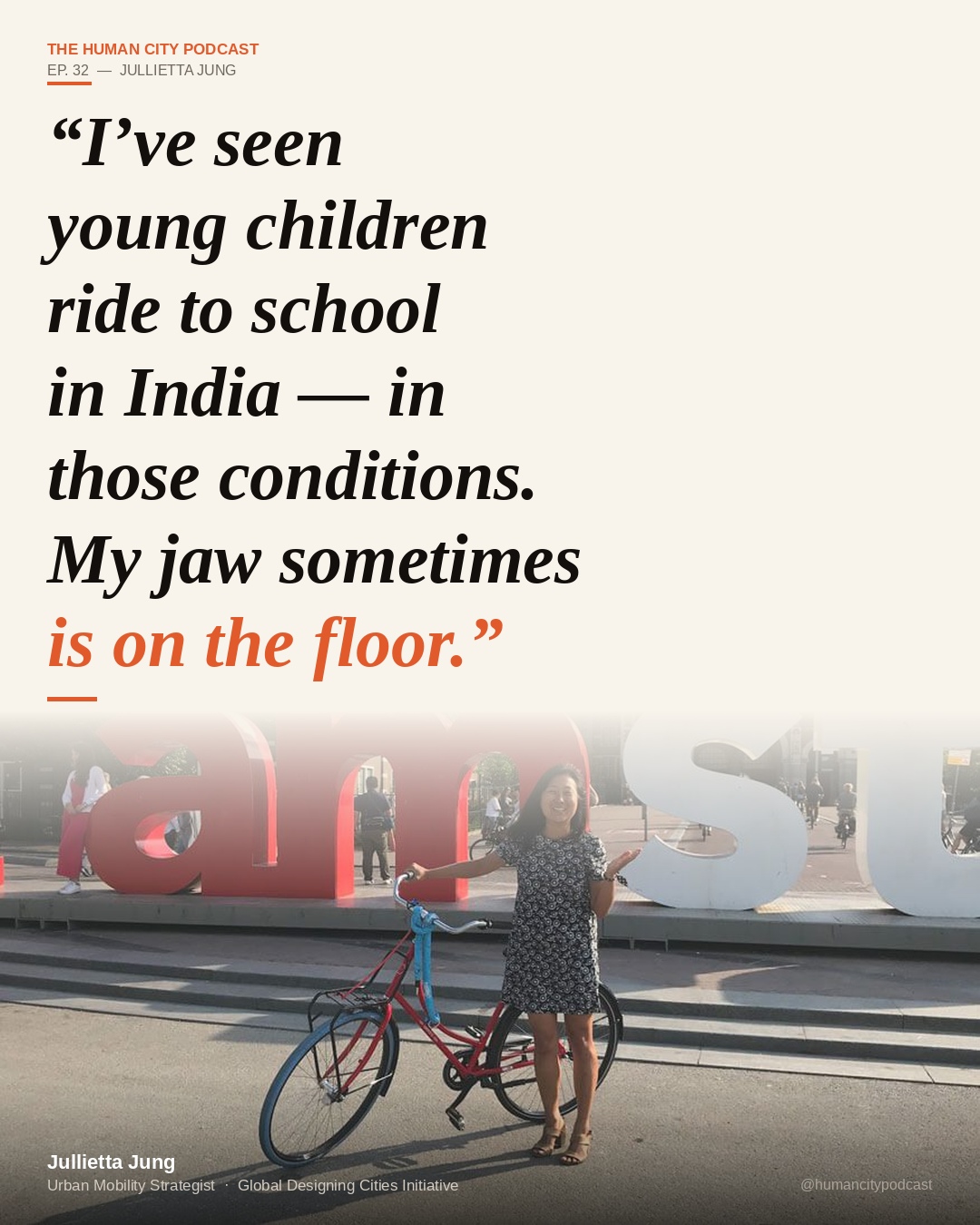
She was not saying this in horror. She was saying it in something closer to awe. Because despite everything — the chaos, the two-wheelers, the absence of any real infrastructure — children in Indian cities are moving. Walking. Cycling. Getting to school on their own.
We just refuse to count them. And because we don't count them, we don't build for them.
THE CONVERSATION
I want to be honest about what I expected from this conversation. I thought it would be technical — design principles, project case studies, implementation challenges. What I got instead was one of the most grounded conversations I've had about what it actually feels like to try to change a city from the inside.
Jullietta has worked in Indian cities. She has sat in the meetings. She knows what it takes and what it costs.
On what a livable city actually means
Every city in India has a vision document that uses the word livable. Almost none of them define it in a way that includes the people most at risk of being excluded.
Jullietta's definition is simple and demanding: a livable city is safe for all people — not just men, but women. Not just adults, but children and the elderly. Not just able-bodied people, but everyone who moves slowly, or needs to rest, or can't cross a wide junction in time.

She adds something most liveability indices miss entirely: heat. Tree canopy. The ability to stand somewhere for ten minutes without being cooked alive. In Delhi, in Pune, in any Indian city that is getting hotter every year — shade is not a luxury. It is infrastructure.
On India and the 15-minute neighbourhood
Everyone loves the idea of 15-minute neighbourhoods. Most people in Indian cities assume it can't apply here — too much sprawl, too much chaos, too different.
Jullietta disagrees. Completely.

The street vendor on the corner. The shop at the end of the lane. The neighbourhood that hasn't been redeveloped yet, where the streets are still narrow enough that you have to leave your car outside. These are not problems to be solved. They are the foundations of what urban planners in Europe are spending billions trying to recreate.
The irony of Indian urban policy is that we are dismantling exactly what makes our cities walkable — in order to build the infrastructure that will make them unlivable.
On two-wheelers, water, and the limits of planning
Working in Pimpri Chinchwad, Jullietta discovered something no textbook prepares you for. On paper, one lane equals one vehicle. In Indian cities, one lane equals six two-wheelers.

This is not a complaint. It is an observation. And it forced her to rethink every assumption she brought from Sydney. The scale is different. The volume is different. The culture of movement is different.
But she also noticed something that doesn't make it into the reports: despite everything, people move. Children cycle to school in conditions that would shut down a school in Australia. Women navigate roads with no footpath. Elderly people cross junctions that are hostile by design.
They are not failing. The infrastructure is failing them.
On COVID, cycleways, and what politics can unlock
Sydney's pop-up cycleways are one of the most cited examples of rapid cycling infrastructure delivery anywhere in the world. Jullietta was part of the team that built 15 kilometres in weeks during the pandemic.
How? She is direct about it: the politics aligned.
This is not an argument against consultation. It is an argument about what is actually blocking cycling infrastructure in most cities. It is not technical. It is not financial. It is political will — the alignment of different departments, different agendas, different leaders around a single moment.
In India, that moment arrives when a progressive commissioner is in post. And then it disappears when they are transferred. Which is, as Jullietta notes, the central problem.
On safety through design, not policing
Jullietta grew up near a library she loved. She stopped going at night — not because of crime, but because the path from the bus stop was dark, narrow and unknown. She got picked up by her mother instead.
That is not a safety failure. That is a design failure.
In India, we have built medians that people climb over because there is no crossing for a kilometre. We have footpaths that end mid-block. We have bus stops with no lighting and no sight lines. And then we wonder why women don't feel safe.
These are not mysteries. They are choices. And they can be unmade.
On wider roads and the speed problem
One of the most counterintuitive things Jullietta said: wider roads are not safer. They are faster. And faster roads are more dangerous especially for people on foot.

Australia is moving toward 30km/h speed limits on local streets — not through enforcement, but through design. Speed humps. Raised crossings. Chicanes. Physical interventions that make it uncomfortable to drive fast.
In India, we are doing the opposite. We build service roads to handle overflow traffic and then wonder why pedestrians end up crushed into the corners.
WHY THIS MATTERS FOR INDIA
Twenty years ago, most Indian cities had 40 to 50 percent modal share for walking and cycling. That number has collapsed — not because people stopped walking and cycling, but because we stopped counting them.
I sat in a meeting in Udaipur in 2016. A mayor asked me directly: how do you claim 40 percent of trips here are by walking and cycling? I don't see it.
And that was the problem. He couldn't see it because we had stopped measuring it. The last national data on how Indians commute in cities is from 2008. Sixteen years ago. Since then — nothing.
We don't lack the tools. We don't lack the models. We lack the will to see what the numbers would show. Because the moment you count the people walking and cycling, you have to build for them.
Jullietta's work in PCMC is one of the rare examples of someone actually trying. Not through grand plans, but through pilots. Service road interventions. School engagement programmes. Inviting the traffic police to come and stand in a modal filter and feel what it's like.
It is slow. It is difficult. It requires a commissioner who gets it, NGOs who show up, and a community that is asked — for once — what it actually wants.
And even then, when that commissioner moves on, it is fragile.