Who Is Transport Really For? HCE31 | Karel Martens| Ruchita Bansal
About this episode
A conversation with Karel Martens, Professor at the Technion and author of Transport Justice — on why transport planning has a justice problem hiding in plain sight.

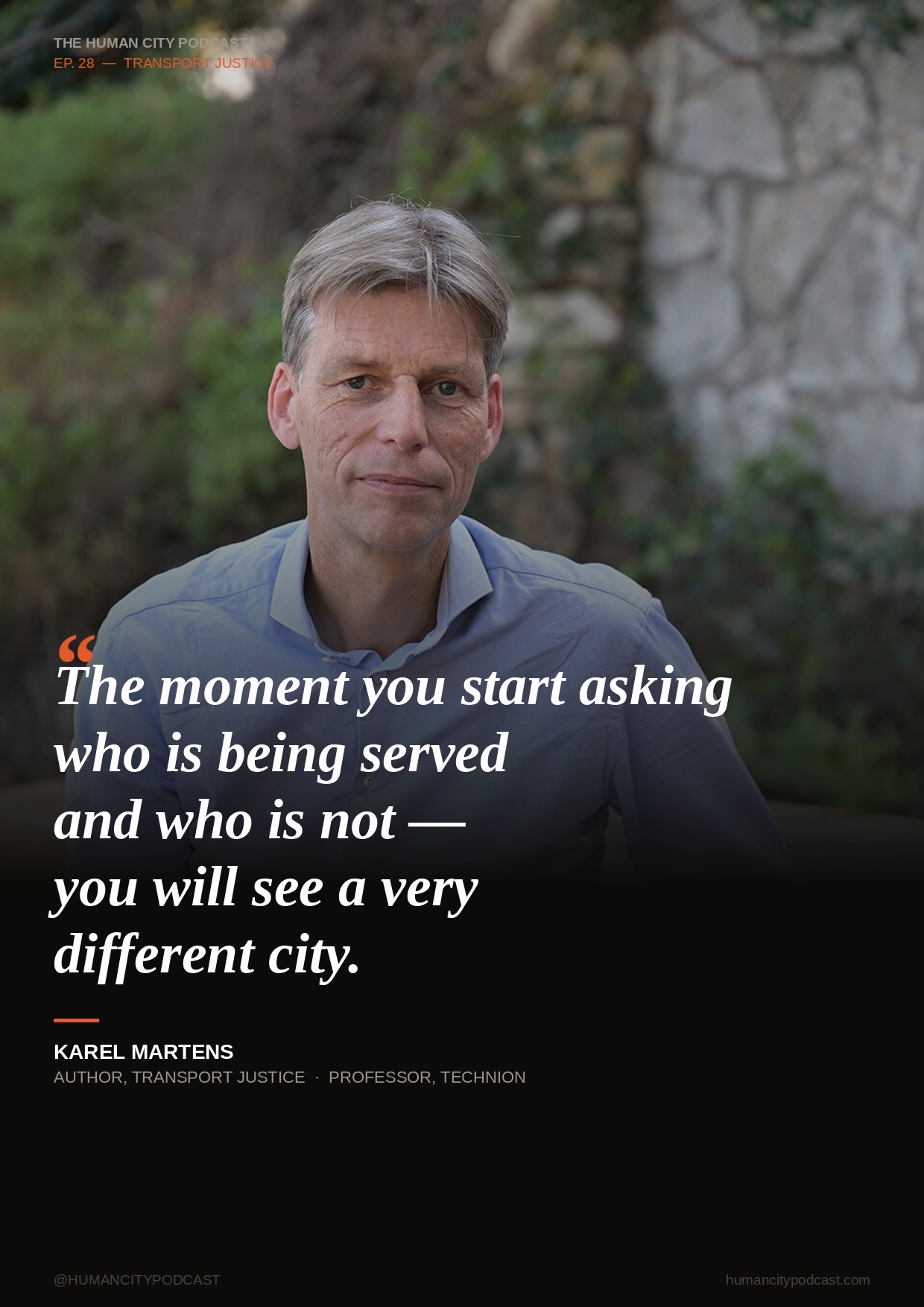
Karel Martens is a professor at the Technion in Israel and the author of Transport Justice: Designing Fair Transport Systems. His book makes the case that transportation planning has operated for five decades with the wrong goal — optimising system performance instead of asking whether people can actually get to the places they need to go. This episode stopped me repeatedly. Because everything Karel describes - the invisible people, the wrong questions, the data that never captures what matters. I have watched play out inside Indian cities for fifteen years.
THE CONVERSATION
I want to be honest about how I went into this episode. I expected a technical conversation — accessibility metrics, modal hierarchies, BRT case studies. What I got instead was one of the most philosophically grounded conversations I have had on this podcast about what cities owe their residents.
Karel is not a polemicist. He is careful, measured, and precise. Which makes the critique all the sharper.
On why planning asked the wrong question for 50 years?
The field of transport planning was largely built by civil engineers who had already successfully designed water systems, sewerage networks, and electricity grids. The logic they brought was: connect everyone to the system, then keep the system flowing. It worked for pipes. It does not work for people.
Water flows. People decide. And once planners borrowed the pipe-and-flow model from civil engineering and applied it to roads, they also inherited its blindness — the assumption that if the system is working, everyone is being served.

The car, when it arrived, seemed to complete the logic. A car for every household. Connect every house to the road network. Keep the roads flowing. Everyone served.
Except, of course, children. Elderly people. Women doing school runs and hospital visits and market trips that do not fit neatly into rush-hour models. Anyone who does not or cannot drive. Anyone who cannot afford to drive.
These people did not disappear from cities. They disappeared from the models.
ON ACCESSIBILITY AS FREEDOM
The word Karel keeps coming back to is accessibility — not in the disability sense, though that is part of it, but in the deeper sense: can you actually get to the places you need and want to get to?
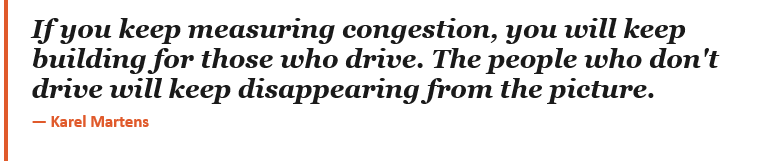
This reframing matters. Because when you measure a transport system by whether it is congested, you get one picture of the world — and that picture is dominated by car drivers stuck in traffic. When you measure it by who can access opportunities, you get a completely different picture. Suddenly congestion evaporates as the central problem. What appears instead is a large share of the population — in every metropolitan region, in every country — who simply cannot get to enough places to live a full life.
In Los Angeles, the emblematic city of the car, one in five adults does not have access to a vehicle. That is not a marginal edge case. That is the system failing 20% of its residents.
ON THE INVISIBLE PEOPLE
When I asked Karel how planners managed to miss this for so long, his answer was both generous and damning.
The children stopped playing in the streets when the cars arrived — so they were no longer visible to the planners in their cars. The elderly person struggling to cross on time does not appear in a traffic model. The woman whose trip chains through a school, a market, and a hospital is not captured in a rush-hour survey designed to count home-to-work commutes.

The models did not capture these people. The surveys did not ask the right questions. And so the data confirmed the assumption: transport is mainly about moving workers from home to the office and back.
What Karel argues for instead is not more data — it is the right data. Ask people not just where they travelled, but whether they wanted to travel somewhere and could not. Ask whether they were dependent on someone else to get there. Ask whether they felt safe making the journey at all.
Those questions reveal a completely different city.
ON PHILOSOPHY AND WHY IT MATTERS?
This is where Karel's book does something genuinely unusual for a planning text: it goes to Rawls, to Dworkin, to political philosophy, to ask what a just transport system would actually look like.
His method is elegantly simple. Imagine you do not know who you will be in a city — rich or poor, abled or disabled, young or old, car owner or not. Now design a transport system you would be willing to live with.
What emerges from that thought experiment is not equality — it is sufficiency. Everyone deserves a baseline level of access to the city. Not the same access as a wealthy car-owning professional. But enough to work, to access healthcare, to participate in social life, to live with dignity.
Sufficiency is not a fixed number. What counts as enough is partly empirical, partly political. But there are clear cases of insufficiency — and most planning systems are not even asking whether those cases exist.
ON WOMEN, TRIP CHAINS AND THE MALE COMMUTE
The standard transport model was designed by men, for a version of city life that mostly did not include women's actual movement patterns.
The home-to-work trip. Modelled in rush hour. Counted as the important journey. Everything else — the school run, the market, the clinic, the elderly parent, the return via the pharmacy invisible.
Karel agrees. The tools were built for a world that never quite existed, and they have been slow to catch up with the world that does. Short trips, complex trip chains, journeys made at off-peak hours — these are statistically underrepresented in models and, as a result, systematically underserved in infrastructure.
ON A MOBILITY TAX AND RETHINKING HOW WE FUND TRASNPORT
One of the most provocative ideas in Karel's book is about finance. Most countries fund transport infrastructure through taxes linked to car use — road taxes, fuel duties, vehicle levies. The political logic is that people who use the road should pay for it.
Karel argues this creates a structural trap. When road funding is linked to car taxes, car users develop a sense of ownership over the money — and resist it being redirected to cycling infrastructure, walking improvements, or public transport.
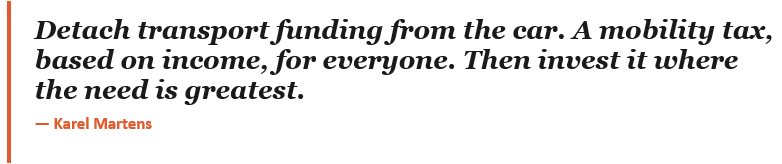
His alternative: a general mobility tax, levied according to income, paid by everyone, directed by government to wherever it does the most good — which, if you are asking the right question, will be the people and places currently least served.
WHY THIS MATTERS FOR INDIA
India is spending at a scale and speed that is genuinely remarkable. Metro lines, BRT corridors, smart city dashboards, expressways, pedestrianised heritage zones. The engineering objects are arriving.
And yet the everyday experience of most people — particularly women, the elderly, children, and anyone without a private vehicle — keeps getting harder. Not easier.
The metro station opens. The last-mile walk to it is broken, unlit, and dangerous after dark. The bus that was supposed to connect the neighbourhood does not run at the frequency that makes it usable. The footpath appears in the plan. It disappears under the parked motorcycles.
What Karel's framework exposes is that this is not a funding gap or an engineering failure. It is a question gap. No one in the room is being asked to demonstrate that their project improves accessibility for the people who have the least of it.
The default user in most Indian city planning remains a fiction: a man who commutes linearly, owns a vehicle, and does not do school runs. The woman who will not wait at that bus stop after 8pm because there is no lighting and no visibility. These are not edge cases. They are the majority.
THREE THINGS I AM STILL THINKING ABOUT
- Congestion is the wrong enemy. When you shift from measuring traffic flow to measuring who can access opportunities, the entire agenda changes. Congestion is mostly a problem for people who are already well-served. Start with the people who cannot get anywhere at all.
- Data does not tell you what to do — it tells you what you chose to measure. Travel behaviour surveys count trips that were made. They do not count the trips that were not made because the system made them impossible. Change the question, and you change what the data can tell you.
- Sufficiency is a more honest goal than optimisation. Optimisation asks: how do we make the system as efficient as possible? Sufficiency asks: does everyone have enough to live a decent life? The second question is harder, less technically elegant, and far more important.
EXPLORE MORE FROM THIS EPISODE